Tuesday, July 22, 2014

Child Rights Violations in DR Congo - UN Report


The recruitment and use of children by armed groups remained endemic in the Democratic Republic of the Congo (DRC) between 2010 and 2013, according to a new United Nations report, which cited impunity as a major factor in the ongoing abuses.

"Impunity has encouraged perpetrators to continue their violations against children," Leila Zerrougui, the Secretary-General's Special Representative for Children and Armed Conflict, told the Security Council Working Group on children and armed conflict today.

Briefing on the 5th Report on Children and Armed Conflict in DRC, she said there were close to 4,200 cases of recruitment and use of boys and girls by armed groups and the Government armed forces. One third of the cases involved children below the age of 15.

"The chronic instability in eastern DRC, the multiplicity of armed groups and the weakness of state authority have made children extremely vulnerable to all forms of conflict-related violence," she stated.

According to a news release issued by the Special Representative's office, the report documented over 900 cases of sexual violence against children committed by all parties to the conflict, while acknowledging that many more children are likely to have been victims of rape and other forms of sexual violence.

The situation was particularly bad in the country's eastern provinces, where children were killed, maimed, victims of sexual violence and abducted by all parties.

Ms. Zerrougui called on the international community to continue supporting the Congolese authorities in their efforts to stop recruiting children into the army. For example, last March, the Government endorsed the 'Children, Not Soldiers' campaign and committed to making its army child-free by 2016. In addition, the Action Plan signed in 2012 by the Government to end the recruitment and use of children and sexual violence by the national army has led to the release of hundreds of children.

"The Government has demonstrated that progress is possible," Ms. Zerrougui said. "The success of the Action Plan is essential. Non-State actors will not give up the recruitment and use of children as long as the country's army continues to be on the Secretary-General's list of child recruiters."

Additional measures to end and prevent the recruitment, such as age verification mechanisms, continue to be put in place and need to be strengthened throughout the country.

The Special Representative added that fighting impunity is crucial to protect the country's children. Perpetrators of grave violations against children must be investigated and prosecuted in a systematic manner.

Thursday, July 17, 2014

Che in Congo


Almost 50 years ago, the mountains towering above Uvira, a lakeside town in South Kivu province, were the scene of some of the opening shots in DR Congo's post-colonial wars.

Che was unimpressed with Congo revolutionaries
In 1965, with the world on a tense Cold War footing, the Latin American revolutionary Ernesto 'Che' Guevara came here to try to spark a left-wing revolution.

Che aimed to pit himself against what he called the "Yankee Imperialists" whom he saw as backing compliant pro-western candidates for power in DR Congo.

Wednesday, July 16, 2014

Che in the Congo


Che in Africa, a review of "THE AFRICAN DREAM: The Diaries of the Revolutionary War in the Congo", by Ernesto Che Guevara.

By Michela Wrong

Published: November 11, 2001

It takes an exceptional man to admit to a resounding defeat. Recounting the almost farcical story of how a group of Cuban fighters set off to save Congo's revolution, only to need saving themselves, a lesser individual would have been tempted to airbrush his memories. Not so Che Guevara. ''This is the history of a failure'' is the frank opening line of ''The African Dream.''

Convinced that the ''Yankee imperialism'' he detested had to be confronted not only at home but in its bases of support, the developing nations emerging from colonialism, Guevara had slipped into Congo in 1965, in the midst of rebel uprisings against the American-supported government that followed the assassination of Patrice Lumumba in 1961. In sending a vanguard of black fighters to pass on to their Congolese brothers the guerrilla tactics that had succeeded in Cuba, Fidel Castro and the Argentinian-born Che Guevara were undertaking a daring experiment in the internationalization of the Communist revolution.

 
 It all looked so good on paper. But the Congolese regarded carrying heavy loads as below their dignity and would wander off, bored, when the Cubans tried to stage ambushes. Superstitious, they relied on ''dawa,'' magic potions whipped up by witch doctors, for victory, emptying their magazines into the sky with eyes shut tight. Worse, ''each of our fighters had glumly witnessed assault troops melt away at the moment of combat and throw away precious weapons in order to flee more quickly,'' Guevara recorded. Their leaders' failings overshadowed the foot soldiers' shortcomings. Laurent Kabila, the supposed head of the revolt, rarely deigned to visit the front. As Guevara sheltered from torrential rain in lice-infested huts, plagued by malaria and dysentery, he received reports of Kabila's drunken binges in Dar es Salaam. Soon, in terms that would be instantly recognizable to a World Bank representative, he is urging Castro to halt unconditional aid. Within seven months the revolution turned into a rout.


But Guevara is too intelligent to put all the blame on the Congolese. The Cubans, he confesses, were overconfident and made amateurish mistakes. They arrived so poorly briefed, they expected to be operating in flat terrain, not mountains. Most tellingly, they simply hadn't done their homework, blithely assuming that the conditions that fueled Latin America's revolutions -- exploitative feudal estates and a land-hungry peasantry -- were reproduced in Africa. In his epilogue, Guevara asks the question that should have been posed long before he booked passage: What did the revolution actually have to offer the peasants of the fertile eastern Congo?

It is a tragicomic tale, cleanly translated by Patrick Camiller, and bleakly funny in parts. For if Guevara must have been a driven, painfully worthy leader, he was also an elegant, ironic writer. There are lessons here for every dewy-eyed aid worker setting off to rescue a doomed community, every International Monetary Fund official proposing to rein in an errant government, every African politician who thinks he knows best.


Published 35 years after it was drafted, the book retains its freshness. The Kivu area the Cubans operated in is still a lawless zone in which ragtag groups of fighters -- known as Mai Mai -- douse themselves in magic water. With their country split by a civil war that Laurent Kabila, once president, had neither the desire nor ability to end, 52 million Congolese can attest to the character faults spotted by Guevara, who would have been amazed by his former ally's successful ousting of Mobutu Sese Seko, if not his assassination earlier this year. In both government territory and rebel-held areas, warlords squabble over turf while taking for granted a grass-roots support they have never worked to acquire. The Congolese people remain as sidelined and irrelevant to proceedings as ever.


Michela Wrong is the author of ''In the Footsteps of Mr. Kurtz: Living on the Brink of Disaster in Mobutu's Congo.''

Wednesday, March 19, 2014

Blood Coltan

The mobile phone is a remarkable piece of engineering. But look inside. There's blood in this machine.  There's blood in this device because your mobile contains tiny electronic circuits, and they couldn't work without mineral called COLTAN.  It's mined in the eastern Congo. There is blood here, the blood of Congolese who are dying in a terrible conflict.

The West’s demand for Coltan, used in mobile phones and computers, is funding the killings in Congo. Under the close watch of rebel militias, children as young as ten work the mines hunting for this black gold.  Blood Coltan exposes the web of powerful interests protecting this blood trade. Meet the powerful warlords who enslave local population and the European businessmen who continue importing Coltan, in defiance of the UN.

To check out "Blood Coltan" click the link below.

https://www.youtube.com/watch?v=in0A8SFL3XM#t=34

Monday, February 24, 2014

Henry Morton Stanley


Most famous for allegedly uttering the words, "Dr. Livingstone, I presume," Henry Morton Stanley was one of the most stanleypic well-known of all nineteenth-century British explorers. In his early years (as a naturalized American) he led a roving life, fighting in the American Civil War, serving in the merchant marine and the federal navy, and reporting as a journalist on the early days of frontier expansion. He became famous when the New York Herald commissioned him to "find Livingstone" in Africa.

After finding Robert Livingstone (no mean feat, since Livingstone was living in the interior of Zanzibar, where even his friends could not find him), and following in the footsteps of Livingstone, Richard Burton, John Hanning Speke, and others, Stanley went on to explore the rivers and lakes of central Africa. Through the Dark Continent (1877) is his account of those explorations. Failing to interest the British government in developing the Congo, Stanley accepted the invitation of King Leopold of Belgium to explore the region -- an expedition that led to the establishment of the "Congo Free State" under the sovereignty of King Leopold, and to Stanley's book, The Founding of the Congo Free State (1885). Stanley continued to explore and write until the end of the century, producing In Darkest Africa in 1890 and Through South Africa in 1898. He died in England in 1904.

Tuesday, February 18, 2014

Leopold and Hitler (the hidden holocaust)

The following is a 1999 book review from the Guardian of the landmark book, "King Leopold's Ghost", by Adam Hochschild, in which Hochschild makes the claim that Leopold's mass murder in the Congo was on par or worse than what Adolph Hitler did to the Jews of Western and Eastern Europe during World War II:

As the sun sank slowly over Brussels, its fading rays glinted off the glass domes and towers of the magnificent Victorian greenhouses in the grounds of the royal palace at Laeken. Built to celebrate King Leopold II's acquisition of the Congo a century ago, the greenhouses stretch for more than half a mile and are among the most visible and grandiose remaining symbols of a once enormous African empire, 60 times the size of Belgium. The colony was the largest private estate ever acquired by a single man - and one he never saw.

It is said that when he showed his nephew the greenhouses, the youth gasped that they were like a little Versailles. 'Little?' snorted the king.
Leopold always did think big. But the row over the king's notorious stewardship of his African territories still has the ability to evoke raw emotions in a country trying to come to terms with a brutal colonial past.

The question is: was the spade-bearded old reprobate a mass-murderer, the first genocidalist of modern times, responsible for the death of more Africans than the Nazis killed Jews? Was his equatorial empire, the setting for Conrad's Heart of Darkness and the terrible Kurtz with the human heads dangling round his garden, the scene of a largely forgotten holocaust? The old wounds have been re-opened by the publication of a book called King Leopold's Ghost, by the American author Adam Hochschild, which has brought howls of rage from Belgium's ageing colonials and some professional historians even as it has climbed the country's best-seller lists.
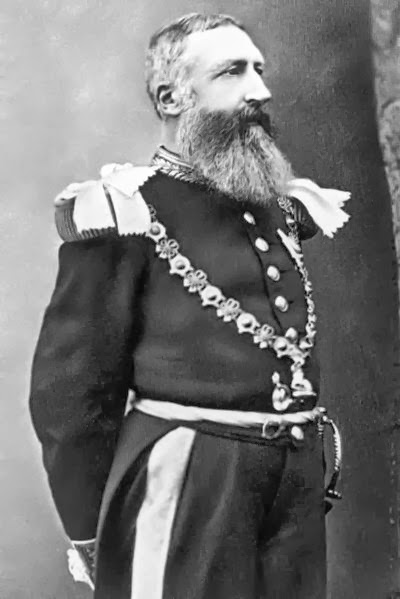
The debate over Belgium's colonial legacy could not be more timely. In the realm beyond the palace walls where Leopold's great grandson Albert II is now king, the openly racist extreme rightwing Vlaams Blok, which blames much of the country's ills on coloured immigrants from Africa, is bidding to become one of the biggest parties in next month's elections.

And the planes which soar over the greenhouses as they depart Brussels sometimes carry human cargo - black asylum seekers being unceremoniously deported, occasionally naked and still bleeding, back to Africa. Last September, the Belgian immigration service succeeded in suffocating one of them, a Nigerian woman called Semira Adamu, 20, on board the plane that was to take her home, by shoving her head under a pillow. The police videoed themselves chatting and laughing while they pushed her head down. It took them 20 minutes to kill her.

The history of Leopold's rule over the Congo has long been known. It was first exposed by American and British writers and campaigners at the turn of the century - publicity which eventually forced the king to hand the country which had been his private fiefdom over to Belgium.

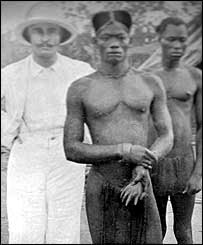
But Hochschild's book has hit a raw nerve for a new generation with its vividly drawn picture of a voracious king anxious to maximise his earnings from the proceeds of rubber and ivory. It is clear that many of Leopold's officials in the depots up the Congo river terrorised the local inhabitants, forcing them to work under the threat of having their hands and feet - or those of their children - cut off. Women were raped, men were executed and villages were burned in pursuit of profit for the king.

But what has stuck in the gut of Belgian historians is Hochschild's claim that 10 million people may have died in a forgotten holocaust. In outrage, the now ageing Belgian officials who worked in the Congo in later years have taken to the internet with a 10-page message claiming that maybe only half a dozen people had their hands chopped off, and that even that was done by native troops. They argue that American and British writers have highlighted the Congo to distract attention from the contemporary massacre of the North American indians and the Boer War.
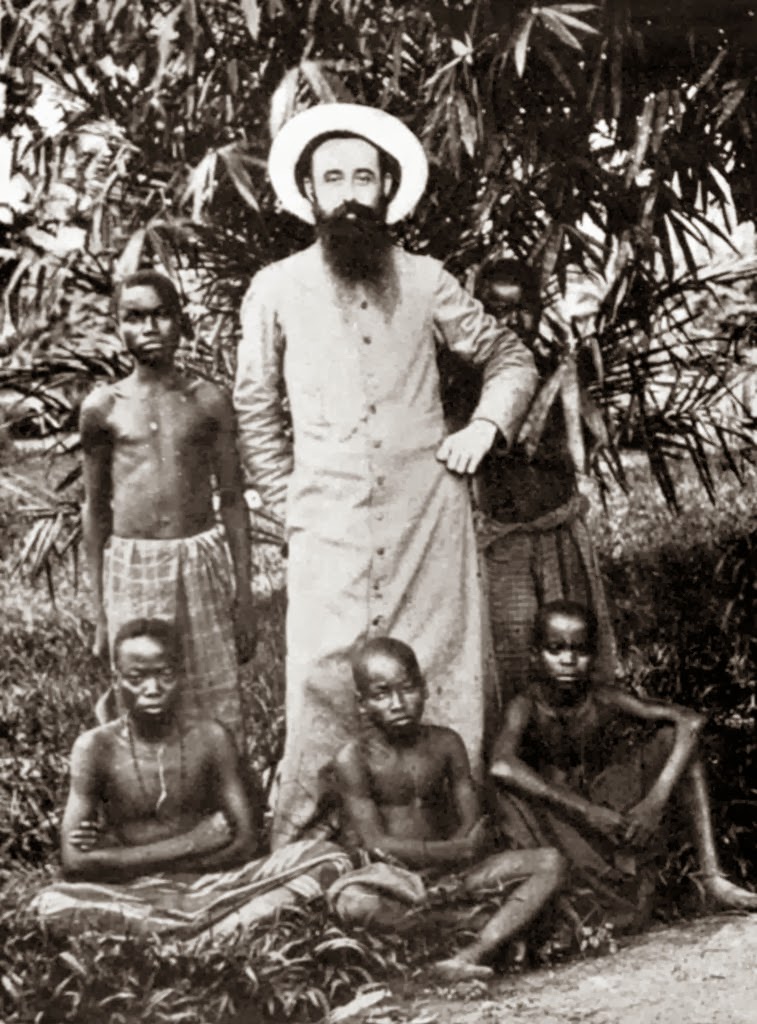
Under the headline 'a scandalous book', members of the Royal Belgian Union for Overseas Territories claim: 'There is nothing that could compare with the horrors of Hitler and Stalin, or the deliberate massacres of the Indian, Tasmanian and Aboriginal populations. A black legend has been created by polemicists and British and American journalists feeding off the imaginations of novelists and the re-writers of history.' Professor Jean Stengers, a leading historian of the period, says: 'Terrible things happened, but Hochschild is exaggerating. It is absurd to say so many millions died. I don't attach so much significance to his book. In two or three years' time, it will be forgotten.' Leopold's British biographer, Barbara Emerson, agrees: 'I think it is a very shoddy piece of work. Leopold did not start genocide. He was greedy for money and chose not to interest himself when things got out of control. Part of Belgian society is still very defensive. People with Congo connections say we were not so awful as that, we reformed the Congo and had a decent administration there.' Stengers acknowledges that the population of the Congo shrank dramatically in the 30 years after Leopold took over, though exact figures are hard to establish since no one knows how many inhabited the vast jungles in the 1880s.

It is true too that some of those reporting scandals had their own knives to grind. Some were Protestant missionaries who were rivals to Belgian Catholics in the region. Yet Leopold certainly emerges as an unattractive figure, described as a young man by his cousin Queen Victoria as an 'unfit, idle and unpromising an heir apparent as ever was known' and by Disraeli as having 'such a nose as a young prince has in a fairy tale, who has been banned by a malignant fairy.' As king, he did not bother to deny charges in a London court that he had sex with child prostitutes. When the bishop of Ostend told him that people were saying he had a mistress, he is reputed to have replied benignly: 'People tell me the same about you, your Grace. But of course I choose not to believe them.' His wiliness in convincing the world that he had only humanitarian motives in annexing the Congo, in persuading the Belgian government essentially to pay for his purchase and in buying up journalists, including the great explorer Henry Morton Stanley, to promote his cause show both cunning and skill.
Emerson claims Leopold was appalled to hear about the atrocities in his domain, but dug his heels in when he was attacked in the foreign press. He did indeed apparently write to his secretary of state: 'These horrors must end or I will retire from the Congo. I will not be splattered with blood and mud: it is essential that any abuses cease.' But the man who (as Queen Victoria said) had the habit of saying 'disagreeable things to people' was also reputed to have snorted: 'Cut off hands - that's idiotic. I'd cut off all the rest of them, but not hands. That's the one thing I need in the Congo.' Although few now defend him, strange things happen even today when the Congo record is challenged. Currently circulating on the internet is an anguished claim by a student in Brussels called Joseph Mbeka alleging he his thesis marked a failure when he cited Hochschild's book: 'My director turned his back on me.' Daniel Vangroenweghe, a Belgian anthropologist who also published a critical book about the period 15 years ago, says: 'Senior people tried to get me sacked at the time. Questions were asked in parliament and my work was subjected to an official inspection.' At a large chateau outside Brussels in Tervuren is the Musee Royal de l'Afrique, which Leopold was eventually shamed into setting up to prove his philanthropic credentials. It contains the largest African ethnographic collection in the world, rooms full of stuffed animals and artefacts including shields, spears, deities, drums and masks, a 60ft-long war canoe, even Stanley's leather suitcase.
There is one small watercolour of a native being flogged, but a visitor would be hard-pressed to spot any other reference to the dark side of Leopold's regime. Dust hangs over the place. A curator has said changes are under consideration 'but absolutely not because of the recent disreputable book by an American'.

The real legacy of Leopold and of the Belgians who ran the country until they were bloodily booted out in 1960 has been the chaos in the region ever since and a rapacity among rulers such as Mobutu Sese Seko which outstripped even the king's. Leopold made £3m in 10 years between 1896 and 1906, Mobutu filched at least £3bn. When the Belgians left there were only three Africans in managerial positions in the Congo's administration and fewer than 30 graduates in the entire country.
Vangroenweghe says: 'Talk of whether Leopold killed 10 million people or five million is beside the point, it was still too many.' I asked Belgium's prime minister, Jean-Luc Dehaene, about the Congo legacy this week. 'The colonial past is completely past,' he said. 'There is really no strong emotional link any more. It does not move the people. It's part of the past. It's history.'